As the name suggests, pancreatic neuroendocrine tumors occur in and around the pancreas. What primarily occurs with this cancer is an upregulation or down regulation of hormonal peptides that are essential in function across the body, including important areas like the brain, lungs, and liver. While the endocrine system is a large system that has components across the body that are susceptible to tumors, this portion will cover tumors that occur primarily in the pancreas and area that the pancreas influences. Because the pancreas is made up of cells that produce their own specific hormone, each type of cell has its own specific type of tumor.
In no specific order of significance, the first tumor that arises in the pancreas is a ß-cell tumor, referred to as insulinoma. The tumors are typically benign, meaning that they are mostly harmless, but have been shown to metastasize, or move from the area in which they originate1. These tumors cause a rise in insulin secretion, resulting in a lowered level of blood glucose. The lower level of blood glucose results in a condition called hyperglycemia which causes a slew of symptoms including headaches, fatigue, lightheadedness, seizures, and loss of consciousness2. Interestingly, more serious conditions that surround metabolic dysregulation like diabetes are very rare in insulinoma3. These symptoms are easily improved by eating more, however, this method only helps with benign tumors. In the rare case that the tumor is malignant, meaning that the tumor attacks surrounding cells, it must be removed surgically or treated with chemotherapy. The surgery is usually safe as the tumor is slow growing2. The primary way to diagnose insulinomas is through biochemical tests. These tests measure the amount of glucose and insulin in the blood but also test for calcium, glycosylated hemoglobin, alcohol, adrenaline, and diazoxide. Insulin and glucose serve as the main marker for diagnosis while the other elements of the test help to distinguish between insulinoma versus other ailments that can lead to hyperglycemia2.
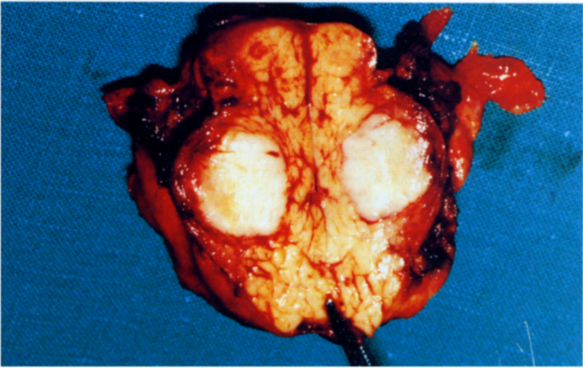
The next tumor to touch on is glucagonoma. This tumor arises in α-cells and over produces the peptide glucagon. This tumor is much rarer than insulinoma and makes up about 1% of all pancreatic neuroendocrine tumors4. Symptoms from glucagonoma include a rash that causes lesions over the body called necrolytic migratory erythema (NME), weight loss, and diabetes. The tumor must be removed before it has a chance to metastasize otherwise treatment can only be done through chemotherapy. Diagnosis relies on recognizing the presence of NME and a blood test to measure the amount of glucagon in the bond. If glucagon concentration exceeds 500 mg/mL then the afflicted most likely has a case of glucagonoma4.
A more well researched tumor occurs with G-cells, gastrinoma, which causes the overproduction of the hormone gastrin. Symptoms of gastrinoma include abdominal pain and Zollinger-Ellison syndrome. This condition acts as the tell-tale sign of gastrinoma due to the rise of stomach and intestinal ulcers caused by an increased amount of stomach acid5. The tumors are typically malignant and must be removed surgically as quickly as possible, and due to the stomach ulcers and pain caused by Zollinger-Ellison syndrome, the tumor diagnosis is fairly easy after a blood test looking for elevated levels of gastrin5.
What causes these tumors though? Four genes have been accredited to the formation of the tumors; MEN1, DAXX, ATRX, and CHES1. The genes code for the proteins menin, death-associated protein 6, transcriptional regulator ATRX, and forkhead box protein N3 respectfully6, 7. Each protein has their own specific function in cell regulation; menin is a tumor suppressor, DAXX is a regulatory protein in transcription and the cell cycle, ATRX forms a complex with DAXX to help modify histones and chromatin in apoptosis, and CHES1 is a transcription checkpoint protein6, 7. MEN1 is the main culprit behind the pancreatic neuroendocrine tumors; it occurs in 44% of analyzed cases. That same group showed that DAXX mutations were present in 25% of the tumors and ATRX was present in 17% of mutation6. DAXX plays an important role in apoptosis, serving as a regulatory protein that helps push cell death forward in the FAS-JNK signaling pathway along with ATRX. Mutations in this pathway would lead to cells continuing to survive and divide, leading to tumors.
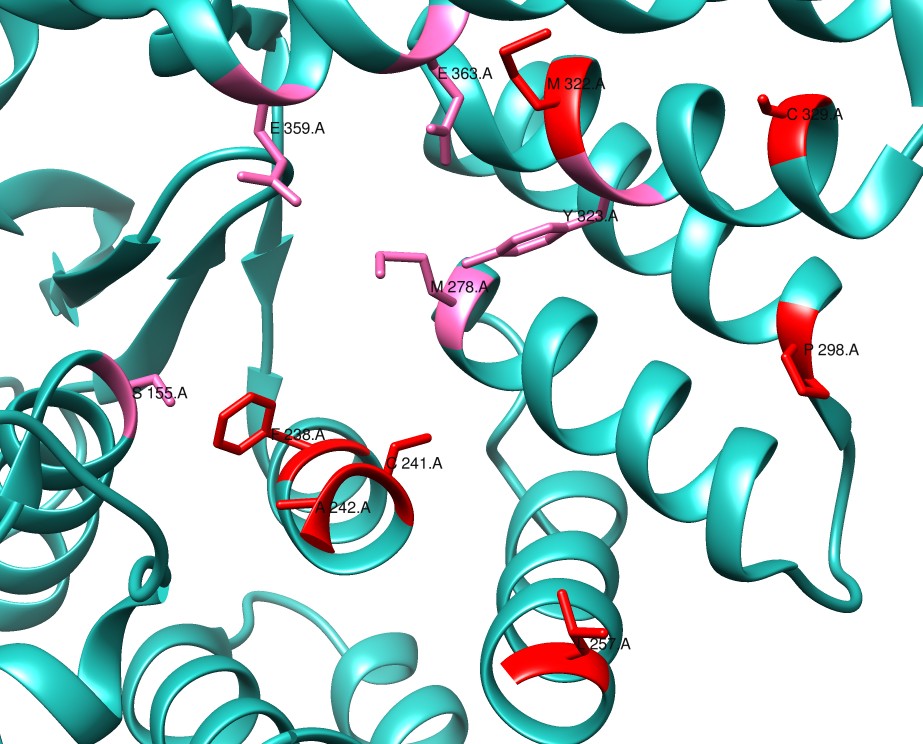
The main perpetrator of pancreatic neuroendocrine tumors, MEN1, has become the primary focus of targeting for most cancers. Menin’s interactions with JUND is a mutation that can lead to issues, as JUND is a transcription factor, and menin blocks JUND from beginning transcription6. An unregulated JUND would continue to transcribe proteins and cause unregulated cell growth, leading to a tumor. Pathways that JUND is involved in include parathyroid hormone synthesis, secretion and action which are hormones in the neuroendocrine system. Future works could include further understanding of pathways that JUND helps transcribe proteins, curious to see if it’s involved in any other neuroendocrine pathways8. Menin binds to the following residue sequence in JUND and MLL1 27SPGRLFPGAPPTAAAGSMMKK47 any mutations at this point will result in issues with binding with JUND and allow it to continue transcription. This motif binds to the amino acids highlighted in figure 2. The specific residues involved in the JUND-menin binding motif are Phe-32, Pro-33, Gly-34, Pro-36, Lys-46, and Lys-47. This motif will be important in the “A Variety of Therapeutic Methods” section so don’t forget it! The following binding motif is also found in MLL1 domains when binding to menin, however, menin acts as an activator to MLL16. Interestingly, it’s been shown that certain mutations can influence how MEN1 creates tumors. Mutations at CHES1 cause a higher chance of MEN1 mutations to not only cause pancreatic neuroendocrine tumors, but also increase the aggressiveness of the tumor9. The mechanism behind this is not yet understood.
MEN1 has come out in recent years to be a key point of mutation in pancreatic neuroendocrine tumors and seems to be a key in treatment. The final section of this story focuses on how the binding motifs in MLL1 and menin can be used as therapeutic targets for inhibitors as well as other chemotherapeutic methods for pancreatic neuroendocrine tumors. Keep enjoying the story and move on to the next section when you’re ready!
1 – Burns, W. R.; Edil, B. H. Neuroendocrine Pancreatic Tumors: Guidelines for Management and Update. Curr. Treat. Options in Oncol. 2012, 13 (1), 24–34. https://doi.org/10.1007/s11864-011-0172-2.
2 – Bliss, R. D.; Carter, P. B.; Lennard, T. W. J. Insulinoma: A Review of Current Management. Surgical Oncology 1997, 6 (1), 49–59. https://doi.org/10.1016/S0960-7404(97)00004-2.
3 – Gittler, R. D.; Zucker, G.; Eisinger, R.; Stoller, N. Amelioration of Diabetes Mellitus by an Insulinoma. N Engl J Med 1958, 258 (19), 932–935. https://doi.org/10.1056/NEJM195805082581903.
4 – Wewer Albrechtsen, N. J.; Challis, B.; Damjanov, I.; Holst, J. J. Do Glucagonomas Always Produce Glucagon? Bosn J of Basic Med Sci 2016, 16 (1), 1–7. https://doi.org/10.17305/bjbms.2015.794.
5 – “Gastrinoma” National Pancreas Foundation. Retrieved 4.22.2022
6 – Jiao, Y.; Shi, C.; Edil, B. H.; de Wilde, R. F.; Klimstra, D. S.; Maitra, A.; Schulick, R. D.; Tang, L. H.; Wolfgang, C. L.; Choti, M. A.; Velculescu, V. E.; Diaz, L. A.; Vogelstein, B.; Kinzler, K. W.; Hruban, R. H.; Papadopoulos, N. DAXX / ATRX , MEN1 , and MTOR Pathway Genes Are Frequently Altered in Pancreatic Neuroendocrine Tumors. Science 2011, 331 (6021), 1199–1203. https://doi.org/10.1126/science.1200609.
7 – Bartsch, D. K.; Slater, E. P.; Albers, M.; Knoop, R.; Chaloupka, B.; Lopez, C. L.; Fendrich, V.; Kann, P. H.; Waldmann, J. Higher Risk of Aggressive Pancreatic Neuroendocrine Tumors in MEN1 Patients With MEN1 Mutations Affecting the CHES1 Interacting MENIN Domain. The Journal of Clinical Endocrinology & Metabolism 2014, 99 (11), E2387–E2391. https://doi.org/10.1210/jc.2013-4432.
8 – Berger, I.; Shaul, Y. Structure and Function of Human Jun-D. Oncogene 1991, 6 (4), 561–566.

Very informative. Can you describe how increased levels of glucagon caused by a glucagonoma would cause a rash (ie. NME)? – Zachary Shuler, M.D. Muhlenberg Class of 2015
Hi Zachary. Sadly, there isn’t an exact known reason as to why glucagonoma causes NME. There are hypotheses that the mechanism behind NME is connected to the liver as fatty acid, zinc, and amino acid deficiency and liver diseases often come with NME as a symptom. Glucagonoma has a frequent tendency to metastasize in the liver very early on in it’s development so it would seem as though glucagonoma’s early movement to the liver would cause NME. It’s possible that spreading to the liver effects the synthesis of these essential building blocks, causing the rash. This question really drives home the fact that the biggest issue with the treatment and understand of pNET’s is that because they’re so rare, so little is really understood about them, making questions like this hard to answer without some level of speculation.
Thank you for such an informative site. The tribute on your landing page is especially touching, and it adds a unique affective register to your work.
In the text on this page, you mention that “future works could include further understanding of pathways that JUND helps transcribe proteins, curious to see if it’s involved in any other neuroendocrine pathways” and “the mechanism behind this [mutation at CHES1 causing both increased likelihood & aggression of MEN1-mutation-induced tumors] is not yet understood.” Do you have any speculation or hypotheses to offer about either one of these pieces of further work? Has any of your research on the subject suggested possibilities?
Nicely done Dave loved the read. I have a question of the types of tumor you were talking about. Does the treatment plan change depending on the tumor? Also is one tumor harder to treat than another?